How Merkle Trees Secure Blockchain and Beyond
Ever wondered how Bitcoin can verify thousands of transactions in a single block without checking each one individually? Or how Git knows exactly which files changed in your repository? The answer is the Merkle tree - an elegant data structure that lets you verify massive amounts of data by checking just a tiny piece of it.
The Problem We're Solving
Imagine you're downloading a file with 1 million transactions from an untrusted source. You need to verify that:
- Nothing was tampered with (data integrity)
- A specific transaction is included (membership proof)
- You can do this efficiently (without checking all 1 million items)
Traditional approach? Hash all 1 million transactions together. But there's a problem: if you want to verify just ONE transaction, you'd need to download ALL of them first!
This is where Merkle trees shine.
What Is a Merkle Tree?
A Merkle tree is a binary tree where:
- Leaf nodes contain hashes of actual data (transactions, files, etc.)
- Parent nodes contain hashes of their children combined
- Root node (Merkle root) represents the hash of the entire dataset
Think of it as a pyramid of trust that collapses all your data into a single fingerprint.
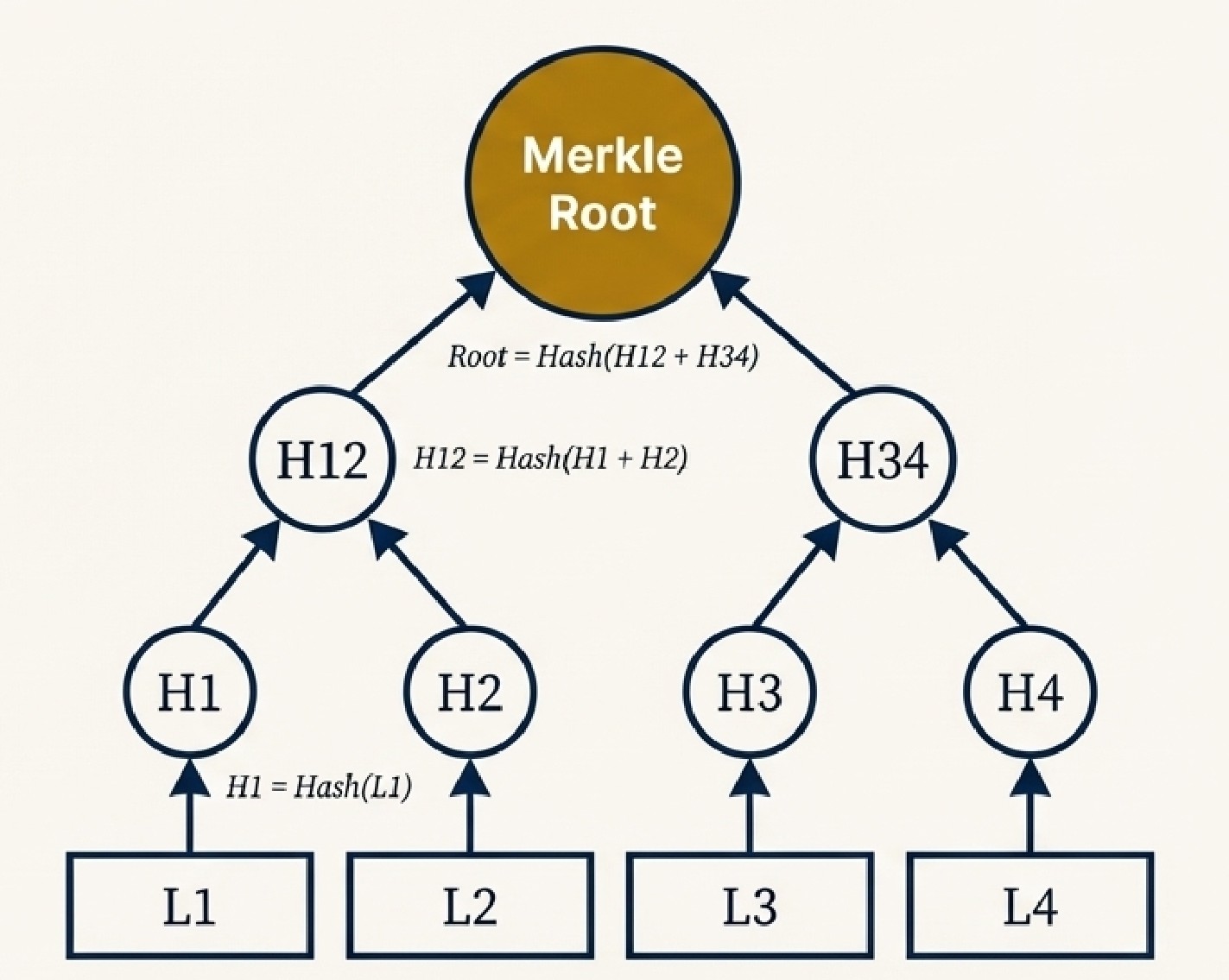
The tree builds from bottom to top:
- Hash each Leaf node individually
- Combine adjacent hashes and hash them again
- Repeat until you reach a single root hash
How Merkle Proofs Work
Here's the magic: to prove L1 is included, you don't need all leaves. You only need:
- Hash(L1) - the leaf itself
- H2 - the hash of L2
- H34 - the hash of L3 and L4
With these 3 hashes, anyone can verify L1 is in the tree by:
- Computing Hash(L1H2) = Hash(Hash(L1) + Hash(H2))
- Computing Root = Hash(Hash(L1H2) + Hash(H34))
- Comparing with the known root
Result: You verified 1 out of 4 transactions using only 3 hashes instead of 4. Now scale this to 1 million transactions: you'd need only ~20 hashes instead of 1 million!
Real-World Applications
1. Bitcoin Block Verification
Every Bitcoin block contains a Merkle root in its header. This enables:
- Light clients (SPV wallets) to verify transactions without downloading the entire blockchain
- Proof of inclusion for any transaction with just a few hashes (~10-15 for typical blocks)
Example: Your mobile Bitcoin wallet doesn't store 500GB+ of blockchain data. It only stores block headers (~80MB) and uses Merkle proofs to verify your transactions.
2. Ethereum State Verification
Ethereum uses a more complex variant called a Merkle Patricia Tree to store:
- Account balances
- Smart contract code
- Contract storage
This allows:
- Stateless clients to verify specific account states
- Light clients to check balances without full node data
- Efficient state proofs for Layer 2 solutions
3. Git Version Control
When you git commit, Git creates a Merkle tree of your files:
- Each file is hashed (blob)
- Directory structures are hashed (tree)
- The commit itself contains the root hash
Benefits:
- Instant change detection: different root = something changed
- Tamper-proof history: changing any file changes the entire commit hash
- Efficient diff operations: only changed branches need rehashing
4. IPFS (InterPlanetary File System)
IPFS uses Merkle DAGs (Directed Acyclic Graphs) to:
- Address content by hash (content addressing)
- Deduplicate identical files across the network
- Verify file integrity on download
- Enable efficient partial downloads
5. Certificate Transparency Logs
Major browsers use Merkle trees to verify SSL certificates:
- All issued certificates are logged in public Merkle trees
- Browsers can verify a certificate is properly logged
- Detects misissued or fraudulent certificates
- Append-only logs prevent tampering
Why Merkle Trees Are So Powerful
Efficiency
For N data items, verification requires only O(log N)hashes:
- 1,000 items → ~10 hashes
- 1,000,000 items → ~20 hashes
- 1,000,000,000 items → ~30 hashes
Security
Changing any leaf cascades up:
- Altering L1 changes Hash(L1)
- Which changes Hash(L1H2)
- Which changes the Root
- The tampered root won't match the trusted root
Scalability
Merkle proofs enable:
- Light clients (verify without full data)
- Sharding (verify cross-shard transactions)
- Layer 2 solutions (commit batches efficiently)
Simple Implementation Example
Here's how you might build a basic Merkle tree in pseudocode:
function buildMerkleTree(transactions):
    // Start with leaf nodes
    nodes = [hash(tx) for tx in transactions]

    // Build tree bottom-up
    while len(nodes) > 1:
        newLevel = []
        for i in range(0, len(nodes), 2):
            left = nodes[i]
            right = nodes[i+1] if i+1 < len(nodes) else left
            parent = hash(left + right)
            newLevel.append(parent)
        nodes = newLevel

    return nodes[0]  // Merkle root

function verifyProof(leaf, proof, root):
    current = leaf
    for sibling in proof:
        current = hash(current + sibling)
    return current == root
Conclusion
Merkle trees are the unsung heroes of modern distributed systems. They transform the problem of verifying large datasets from "download everything and check" to "download a tiny proof and verify instantly."
Every time you:
- Send a Bitcoin transaction from your phone
- Use a light Ethereum wallet
- Push code to GitHub
- Download from IPFS
You're leveraging the power of Merkle trees. They're proof that elegant mathematics can solve real-world problems at scale.
However, Merkle trees are not a silver bullet. You must trust the Merkle root comes from a reliable source, and they don't protect against withholding attacks where valid data is hidden. For efficient updates, additional structures like Merkle Patricia Trees are required. Tree balance also matters because unbalanced trees reduce efficiency. Most implementations use padding for incomplete levels to maintain balance.